
Dog Care

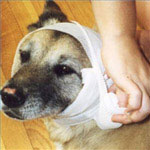
BITE WOUNDS
Muzzle the animal if the animal is not allowing or you fear him of bitting, Check the wound. Clean the wound with large amounts of water or hydrogen peroxide.
Wrap large open wounds to keep them clean. Apply pressure to profusely bleeding wounds. Do not use a tourniquet.
Bite wounds should be examined by the vet.
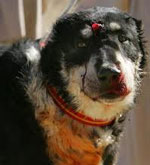
BLEEDING
Apply firm, direct pressure over the bleeding area until the bleeding stops. Hold the pressure for at least 10 straight minutes do not release till a clot develops.
Call your veterinarian immediately.

BREATHING STOPS
If you hear a heartbeat but not breathing, close the his/her mouth and breathe directly into its nose–not the mouth–until the chest expands. Repeat 12 to 15 times per minute. If there is no pulse, apply heart massage at the same time.The heart is located in the lower half of the chest, behind the elbow of the front left leg.
Place one hand below the heart to support the chest. Place other hand over the heart and compress gently. To massage the hearts of cats and other tiny pets, compress the chest with the thumb and forefingers of one hand. Apply heart massage 80-120 times per minute for larger animals and 100-150 per minute for smaller ones. Alternate heart massage with breathing. Often revival from such situation is not rewarding.
Call your veterinarian immediately.
BURNS
The burns could be caused by chemical, electrical or heat including from a heating pad. The symptoms might include singed hair, blistering, swelling, redness of skin. Wash the site immediately with large amounts of cool, running water. Apply an ice pack for 15-20 minutes.
Wrap the pack in a light towel or other cloth. If your pet has large quantities of dry chemicals on its skin, brush them off. Water may activate some dry chemicals.
Call your veterinarian immediately.
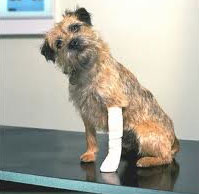
FRACTURES
The symptoms for the same are pain, inability to use a limb or limb at odd angle. Do not try to set the fracture by pulling or tugging on the limb.
Transport the pet to the veterinarian immediately, supporting the injured part as best you can.
HEATSTROKE
Some of the symptoms of heatstroke are rapid or labored breathing, vomiting, high body temperature, collapse. Wrap the animal in a cool wet towel. Do not overcool the animal. Stop cooling when rectal temperature reaches 103 degrees Fahrenheit.
Call your veterinarian immediately.
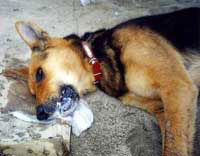
POISONING
Some of the symptoms are vomiting, convulsions, diarrhea, salivation, weakness, depression and pain. Record what the pet ingested and how much.
Immediately call your veterinarian.
Do not induce vomiting without consultation.
SEIZURES
Salivation, loss of control of urine or stool, violent muscle twitching, loss of consciousness are some of the common symptoms.
Move your pet away from any objects that could be harmful during the seizure. Use a blanket for padding and protection. Do not hold firmly the pet during the seizure. Time the seizure. They usually last only 2 to 3 minutes. Afterwards, keep the animal calm and quiet.
Call your veterinarian immediately.

VOMITING
Avoid food for 12-24 hours. Try giving your pet ice cubes two hours after the vomiting stops, then slowly increase the amount of water and foods given over a 24-hour period. He may not eat but continue liquids to prevent dehydration.
Call your veterinarian.